
Trending
This story is from August 5, 2020
Epic touch to Mughal-e-Azam’s masks, sets & paper horses from Pune sculptor
The epic film Mughal-e-Azam, which completes 60 years on Wednesday, has a distinct Pune touch. The lavish sets that added grandeur to the 20-reel movie were designed by noted Pune sculptor B R alias Appasaheb Khedkar, the art director.
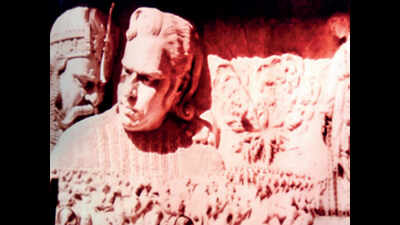
Appasaheb Khedkar was famous for making Ganapati idols and statues for pandal decoration.
Khedkar was famous for making Ganapati idols and statues for pandal decoration. Impressed by his skills director K Asif offered him Mughal-e-Azam. It was his first film as art director. Khedkar had also designed the sets of another epic film Pakeezah, subsequently concentrated on sculpting and was known for his mastery in the statues of Chhatrapati Shivaji Maharaj.
“My father worked in an era when technology had not progressed much in the film industry. He was the first to introduce a rubber mask in films when he made a one of actress Madhubala which was worn by a male Kathak dancer Laxminarayan while shooting the song ‘Pyar kiya to darna kya’ because the actress could not do the famous pirouettes. The mask was so perfect that when K Asif first saw the mask-wearing Laxminarayan dressed as Anarkali (Madhubala), he could not believe it was not the actress herself,” recalled Khedkar’s daughter Seema Shirke, who is carrying forward his legacy.
For making the mask, Khedkar first made a plaster of paris statue of the actress for which she modelled herself. “He then made a face cast from paper pulp and approached a balloon factory to get a rubber mask done. He had also made a mask of actor Dilip Kumar who has essayed the role of Salim. Once, my father told his assistant to wear that mask and meet K Asif. When Asif saw ‘Dilip Kumar’ in his office he was taken aback and asked him what he was doing there since he had no scenes to shoot that day,” Shirke said.
It was Khedkar who again came to the rescue of Asif while shooting the scene showing a chained Anarkali being dragged into Akbar’s court.
“Madhubala was quite delicate and it was apparent that she could not bear the weight of the iron chains. So my father made them from plaster of paris,” Shirke said, adding that many of the 400-odd horses used in the battle scenes were made of paper by her father as it was not possible to get so many for shooting.
When Mughal-e-Azam was released on August 5, 1960 in 150 theatres including Maratha Mandir in Mumbai, Khedkar made a massive panel measuring 24 ft x 12ft depicting Dilip Kumar and Madhubala which was installed outside Maratha Mandir. “Just the faces measured six feet. Father used clay and plaster of paris to fashion that panel,” Shirke said.
She said her father, who passed away in 2016 at the age of 92, was sculpting till he was 90 years old.
“The last sculpture he did was a one-and-a-half-feet face of Madhubala which is our studio. He did it from memory,” Shirke added.
Stay updated with the latest news on Times of India. Don't miss daily games like Crossword, Sudoku, and Mini Crossword.

About the Author
Manjiri DamleEnd of Article
FOLLOW US ON SOCIAL MEDIA








Photostories
Hot Picks
TOP TRENDING
Explore Every Corner
Across The Globe
Unitedhealth Group CEOHow to Watch IND vs AUS MatchPrince WilliamCreative HobbiesBrain Exercises to improve memory
CBSE Date SheetStrategy to Master Learning Faster Than EverMaharashtra CM Oath CeremonyBorder Gavaskar TrophyCSK Full Squad
Popular Categories
Hot on the Web
Top Trends
Trending Topics
Mamta KulkerniPushpa 2 ReviewVikrant MasseyAmitabh BachchanWeight GainBaba Vanga PredictionsAmitabh Bachchan HomePushpa 2 Movie ReviewPushpa 2 LeakedOptical illusionSamantha HouseBaba Vanga Predictions 2025Hair RegrowSkincare Tips for WinterWeight Loss TipsHair FallBill GatesSpotify Wrapped 2024Elon Musk
Living and entertainment
Latest News
7500-year-old ‘Snake Person’ head found, sparks mysteryWhy Rohit Sharma's decision to open with KL Rahul makes senseNo Russian oil flowing through Druzhba pipeline to Czech Republic, Unipetrol says'Well-planned conspiracy, attempts being made to attack our mosques': Omar AbdullahVivah Panchami 2024: Date, Time, Puja Rituals and SignificanceCyberattacks to spike in 2025; healthcare and finance sectors at risk: ReportWill The Rock make a surprise WrestleMania 41 appearance in Las Vegas? WWE star leaves mysterious Vegas remarkNASA's James Webb Telescope discovers fourth planet in the Kepler-51 systemMalaysia's Najib presents fresh evidence to boost house arrest bidThe troubled history of South Korean presidentsUGC announces 7 major changes for UG and PG courses: Multiple entry-exit, biannual admissions and other key reforms explainedTop Honda Amaze features that Maruti Dzire, Hyundai Aura, Tata Tigor miss out on: DetailsFired Hyderabad techie's post goes viral: Received email with subject line "Employment Status"...Sukhbir Singh Badal performs service at Takht Sri Kesgarh Sahib under tight security in RoparKanthar Ghor: A house draped in stories, woven by neighbourhood women in SantiniketanBuoyant India aim to prove a point in pink ball Test against AustraliaRavi Shastri confident Adelaide debacle of 2020 won't affect India in pink-ball TestUnderstanding Multiple Sclerosis: The role of diet and lifestyle in managing MS risk
Copyright © 2024 Bennett, Coleman & Co. Ltd. All rights reserved. For reprint rights: Times Syndication Service